For Clients

You know something's not right.You just don't know why.

A chronic feeling of being stuck.
The same relationship playing out again, no matter who it's with.
A hollow ache in your chest - or the sense you're not fully inside your own life.

First-time client booking directly? Select “Intake Consultation & Assessment”.

What I Treat

Now, let's find out what to call it.

Not a diagnosis - three plain-language shapes this often takes. Tap a card to see more.

Sound Familiar?

CPTSD

"Something happened, again and again, and it shaped who you became."

Complex trauma from prolonged or repeated experiences - often relational, often beginning in childhood - that shapes how you regulate emotion, trust others, and see yourself, long after it ended.

Standard PTSD treatment targets a single event. CPTSD comes from cumulative, relational injury, so this work builds safety and regulation first, then addresses identity and attachment, not just memory - using EMDR, schema therapy, and a body-based approach to regulation.

Often shows up as:

Overwhelm-numbness swings Shame that won't shift Deep worthlessness Harsh inner critic Unstable identity Unexplained tension Mismatched fatigue Persistent void

Underneath most of this are parts of you still frozen in an earlier moment - still bracing, still protecting, long after the danger has passed. Feeling undeserving of success, repeating the same partner pattern, parenting on autopilot, or burnout that won't lift are often that same protection, still running.

Is CPTSD a "real" diagnosis if it's not in the DSM-5?

Yes. It's recognised in the ICD-11 (2022) as distinct from PTSD, so it has formal clinical grounding even though the US diagnostic manual hasn't caught up yet.

Why does the shame in CPTSD feel so constant, not occasional?

Because it usually isn't a reaction to something you did - it's a chronic, background sense of being fundamentally wrong or unworthy, one that can outlast the actual danger by decades. It often formed as protection: believing "it was my fault" can feel safer to a child's mind than accepting there was nothing they could have done.

Get the Free Guide ↓

Sound Familiar?

Dissociative Disorders

"You feel disconnected, like you're watching your life from somewhere outside it."

The mind's protective response to overwhelm, become a lasting pattern: fragmentation, lost time, or feeling unreal. Ranges from everyday spacing-out to more complex presentations like DID.

Dissociation is not a switch, it's a spectrum: from everyday daydreaming, through zoning out under acute stress, to OSDD (distinct parts, without full amnesia) and DID (distinct identities, with amnesia). Most people carrying it sit somewhere in the middle, not at either extreme.

What it can look like:

Feeling detached from your body The world feeling unreal or dreamlike Gaps in memory / "losing time" A sense of internal "parts" Switching between different ways of being Hearing internal voices Emotional numbness Trouble feeling present

Treatment follows ISSTD clinical guidelines across three phases, never rushed: safety and stabilisation first, then trauma processing, then integration into daily life - working directly with parts, rather than around them.

Am I making this up? Is DID even real?

These are honest, common questions, not signs you're inventing anything. Dissociative disorders are recognised in both the DSM-5 and ICD-11. Many people who go on to be diagnosed ask themselves this exact question for years before ever raising it with anyone.

Isn't DID rare, and aren't people with DID dangerous?

Neither is true. About 3.7% of people meet criteria for DID, comparable to bipolar disorder, so this is far from a curiosity. And people with DID are far more likely to be victims of violence than perpetrators - the disorder arises from being harmed, not from causing harm.

Explore the Articles →
Sound Familiar?

Omission Trauma

"Nothing bad really happened. But something is still missing, and you don't know why."

The wound of what didn't happen - the attunement, protection, or acknowledgment that never came. Often invisible, rarely named, deeply formative.

This is the wound Dr. Andre writes about as the Nothing Happened™ trauma therapist.

It rarely looks like trauma from the outside. There's no single event to point to, just an absence, carried quietly, often for years.

It tends to show up as the person who never complains and pre-emptively decides their needs aren't big enough to mention; the person almost wishing something clearly bad had happened, so the pain would have a reason heavy enough to justify it; fierce independence that never occurs to itself as optional; or a loneliness that makes no sense on paper, because the people were there, but a particular kind of being met never was.

Nothing actually happened to me. How can this be trauma?

Because trauma isn't only caused by what happens to you - it can come from what should have happened and didn't. The wound of absence, missing attunement, protection, or acknowledgment, is real and treatable, even without an event to point to.

Why do I feel so much shame, if nothing really happened to me?

Because omission trauma tends to teach a very specific, chronic shame: the sense that needing something was itself the problem. Without an event to point to, many people quietly conclude the fault must be in them, not in what was missing.

Read: "How Omission Trauma Shows Up in Adulthood" on Substack →

Get the Free Guide ↓

Still not sure? A free Discovery Call is the fastest way to find out - no need to arrive with the right word for it.

Dr. Julia A. Andre
Who You're Working With

A decade building the work that reaches this wound

I kept seeing the same gap: people who had done real therapeutic work, carried genuine insight, and remained unchanged in the feeling state. That gap became the focus of a decade of clinical work - and this method, now built to hold Complex PTSD, dissociative presentations, and omission trauma in the same room.

Certified EMDR Therapist Advanced Schema Therapist ISSTD Certified
Read the Full Bio
The Approach

Four moves. Each building on the last.

Most trauma therapy was built around events. This method was built around what doesn't fit that shape - complex, cumulative trauma; dissociative fragmentation; and the trauma of absence. The wound is not only in the narrative; it lives in the body, the nervous system, and the parts that formed before language. Reaching it requires a different kind of contact.

01

Name It

These experiences were rarely named as what they are, and that is part of the wound. Precise language, without having to justify it, is often the first corrective experience.

02

Map It

A clear picture of the internal world: the parts that carry the wound, the parts that adapted around it, the protectors still running - including dissociative parts where they're present.

03

Settle It

The nervous system needs to feel safe, not just be told it is, before it can explore. The first stretch of any work is dedicated to building that - everything else depends on it.

04

Repair It

Group work and individual sessions, each doing what the other cannot. Witnessed by others who understand without explanation. Reached, in traditional individual sessions, where the work needs to go deeper.

A sunlit sofa, a warm and quiet place to sit
Free Guide

Want to look around first? Start here.

A low-commitment way in, matched to what you just recognised above.

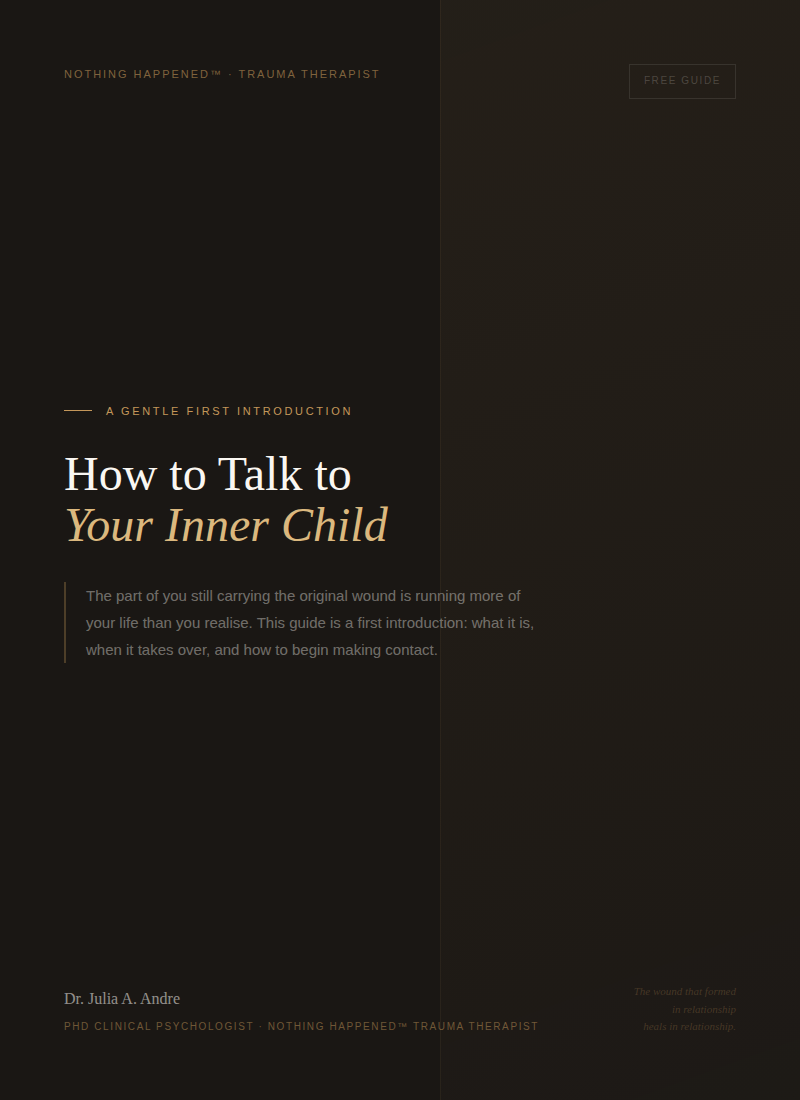
How to Talk to Your Inner Child - a free guide by Dr. Julia A. Andre
Free Guide · Inner Child Work

How to Talk to Your Inner Child

The part of you still carrying the original wound is running more of your life than you realise. This guide is a gentle first introduction: what the inner child actually is, how to recognise when it's speaking, how to begin making contact, a simple practice to try this week, and what to expect as you start.

    Sent immediately. No sequence. No pressure.

    Prefer to just read for now? The Articles → are free, no email required, or browse Dr. Andre's published books →

    At a Glance

    Four ways in, one method underneath.

    Compare formats and pricing, then read the full detail below for whichever fits.

    Understanding

    On-Demand Course

    US$615

    Self-paced · 7 hours · Lifetime access

    Learn More ↓
    Building the Healthy Adult

    The Healthy Adult Group

    US$2,000

    8 weeks · Live group · Max 12

    Learn More ↓
    Deep Processing

    Traditional Individual Sessions

    From US$385

    Per session · 75 minutes · Worldwide

    Learn More ↓
    Concentrated Processing

    EMDR & Trauma Intensives

    Price on Request

    2.5–38 hours · In person or online

    Learn More ↓
    Understanding

    On-Demand Course

    Founding Cohort · Launching November 2026

    Seven hours of clinical framework - the precise language for what you have been carrying, why it formed, why nothing has fully shifted it, and what reaching it actually requires.

    See the Full Curriculum (7 Modules)
    1. Why Insight Hasn't Been Enough

    2. Naming What You're Carrying: CPTSD, Dissociation & Omission Trauma

    3. The Nervous System and Real Safety

    4. Your Inner World: Parts, Protectors & Dissociative Patterns

    5. Why the Same Patterns Repeat

    6. The Wound Behind High Achievement

    7. Building the Adult Who Can Hold It

    Founding Cohort

    US$615 ≈ HKD 4,800

    One payment · Lifetime access · All devices

    Price locks at US$615 for founding members - future cohorts will be US$775.

    • Seven hours of video content across seven modules
    • Workbook and audio for every module
    • Begin immediately, move at your own pace
    • Return to any module at any time
    • One live group Q&A call with Dr. Andre - founding cohort only

    Course graduates arrive at The Healthy Adult Group already fluent in the framework - the strongest, fastest path to a place in a cohort. A US$300 credit (≈ HKD 2,340) applies toward your Group enrolment.

    Join the Founding Cohort Waitlist
    Building the Healthy Adult

    Witnessed.

    The Healthy Adult Group

    8 weeks · Live group · Dr. Andre · Max 12

    Eight weeks of live group work with Dr. Andre: inner safety, mapping, voice work, and repair. The group is not the context for this work, it is the mechanism. The wound forms in relational absence or overwhelm, and it heals in relational presence.

    Every application reviewed individually Safety-first pacing Relational, not solitary, healing
    See the Full Curriculum (4 Phases)
    1. Inner Safety

      Building the regulation capacity the work requires.

    2. Mapping

      A clear picture of the parts, the wound, and how they formed - including dissociative parts and protectors.

    3. Voice Work

      Meeting and strengthening the healthy adult within.

    4. Repair

      Relational healing through witnessed presence, for complex trauma and omission alike.

    Eight sessions of 75 minutes · one private 1:1 with Dr. Andre included

    Deep Processing

    Traditional Individual Sessions

    One-to-one · Tailored · Worldwide

    One-to-one work using EMDR, Schema Therapy, and somatic processing - tailored to what you're carrying. It reaches what understanding and group work prepared but did not complete. The first session sets the direction. This is where the wound closes.

    "Something reached a place that 10 years of talking therapy never touched."

    M.L. · Managing Director

    Deepest Individual Work

    US$410 ≈ HKD 3,200

    First session · 75 minutes

    US$385 ≈ HKD 3,000

    Each session after · 75 minutes · No package required

    • In person in Hong Kong, Bali or Bangkok, or online worldwide
    • Weekly, or scheduled closer together if that suits you better

    Limited availability · confirmed via Discovery Call

    Book a Free Discovery Call

    Already worked with me, or know you're ready? Book directly → (select “Intake Consultation & Assessment”)

    Concentrated Processing

    EMDR & Trauma Intensives

    EMDR Intensive Trauma Intensive Asia-Based

    Half-day to multi-day · In person or online

    Most therapy happens in weekly 50-minute sessions. Trauma processing doesn't always fit that shape. A trauma intensive delivers the same clinical work - EMDR, Schema Therapy, somatic processing - in a longer, condensed sitting: half a day up to several days, often enough to open, process, and close a memory in one sitting instead of reopening it briefly for months.

    I was among the first therapists in Asia to offer structured, multi-day EMDR and trauma intensives.

    This is a significant part of the practice, not a side offering - an intensive is often the fastest, most direct route through for anyone ready to go deeper than a weekly cadence allows.

    See Both Intensive Formats
    1. Single-Incident Intensive

      Half a day to around three days, focused on one specific event - an accident, an assault, frontline or first-responder stress, a difficult divorce, a diagnosis, or a "stuck" belief quietly limiting daily life.

    2. Story-Clearing Intensive

      Four to five days, working through the fuller arc of what happened rather than a single incident - suited to childhood material, attachment wounds, or the accumulated impact of instability.

    The advantages of intensive formats are documented in the trauma research, including Greenwald et al.'s work on intensive trauma-focused therapy (European Journal of Psychotraumatology, 2021).

    Read more: What Is an EMDR Intensive Retreat? →

    Fastest Route Through

    Price on Request

    • Structured around your specific need - single-incident or story-clearing
    • EMDR, Schema Therapy, and somatic processing in an extended format

    Total length 2.5 to 38 hours, scheduled within a month.

    Enquire About an Intensive
    Questions Worth Answering

    Not sure yet?

    Do I need to start with the course, or can I begin with traditional individual sessions or an intensive?

    There is a logical order to the course, the group, and traditional individual sessions, but it is not mandatory. If you have done significant work already, a first session will establish the right entry point for you, whether that is traditional individual sessions or an intensive. That assessment is part of the process. You leave with a clear direction.

    What's the difference between traditional individual sessions and an intensive?

    Both are one-to-one clinical work using the same core modalities - EMDR, Schema Therapy, somatic processing. Traditional individual sessions run in a weekly 75-minute rhythm, well suited to steady, ongoing work. An intensive condenses that same work into one extended sitting, from half a day to several days, for when there's a specific memory or period to move through more directly, or when a weekly cadence isn't enough. Many people use both, at different points.

    Is this a programme I work through alone, or is there live contact?

    Both. The on-demand course gives you the framework at your own pace. The live group sessions are where the experiential work happens, alongside others who share the same starting point. Individual sessions can run alongside the group, follow it, or stand alone as a starting point when that's the better fit.

    What if I have never done therapy before?

    The course is designed precisely for that starting point. It gives you the framework and language before any live work begins. Many people find it easier to enter group or individual work once the terrain has been named. There is no prerequisite beyond recognising yourself in what this describes.

    What does a Healthy Adult Group session actually look like?

    Each group session combines a short piece of psychoeducational content with guided experiential practice. You are introduced to a concept, then invited into an exercise, often somatic or imagery-based, that brings it into direct contact with your inner experience. There is no lecturing and no homework in the traditional sense. The sessions are designed to be felt as well as understood.

    Do I have to talk about specific memories or go back to the past?

    Not in the group. This programme is about stabilisation, not trauma processing - building the inner resources that make processing possible later. You won't be asked to recount memories, revisit events, or explain your history here. The work is experiential and present-focused: what's happening in you now, which parts are active, and what they need.

    Is the group safe, and will it feel exposing?

    Both are fair questions. The group is capped at 12, every application is reviewed individually, and the first two weeks focus entirely on building inner safety before anything deeper begins. Most people arrive expecting the group to be the hard part, and find that sitting with others who already understand, without having to justify any of it, is one of the most relieving parts of the process.

    How long before something shifts?

    Some people notice a change in how they relate to themselves within the course alone, not because the wound is gone, but because it finally has a name. Deeper shifts, in the feeling state rather than the narrative, develop through the live work. There's no fixed answer to that. But this is not an indefinite process - the method is designed to move.

    Not Sure Yet? Start Here

    The Discovery Call

    15 minutes with Dr. Andre, one-to-one. You will leave knowing whether this work is right for you, at no cost and no commitment.

    Free · No commitment 15 minutes · virtual By appointment
    Book a Free Discovery Call →