Dissociation.
Watching your life from outside it.
“You feel disconnected, like you're watching your life from somewhere outside it.”
The mind's protective response to overwhelm, turned into a lasting pattern: fragmentation, lost time, or feeling unreal. It ranges from everyday spacing out to more complex presentations like DID.
- Feeling detached from your body
- The world feeling unreal or dreamlike
- Gaps in memory, or “losing time”
- A sense of internal parts
- Switching between ways of being
- Hearing internal voices
- Emotional numbness
- Trouble feeling present
Treatment that works with parts, not around them.
Treatment follows ISSTD clinical guidelines across three phases, never rushed: safety and stabilisation first, then trauma processing, then integration into daily life.
Parts work maps who is there and what each part is protecting, so the parts can start to work together.
Most people carrying dissociation sit somewhere in the middle, not at either extreme.
Every part is welcome. Nothing is forced.
Safety and stabilisation
We build a shared map of how dissociation shows up for you: when you lose time, feel unreal or switch. We work on grounding, daily-life functioning and communication between parts. Parts that protect you are treated as allies, not obstacles.
Careful trauma processing
Only when your system is ready, and only with the agreement of the parts involved, do we approach traumatic memories, in small doses and with the whole system in mind. For some people this phase is short. For others it is where most of the work happens.
Integration
Over time the parts work together more smoothly. Some people move towards feeling like one self, others towards cooperation between parts. Either way the goal is a life that feels more continuous and more your own.
This follows the ISSTD guidelines for treating dissociative disorders.
What people often ask.
Am I making this up? Is DID even real?
These are honest, common questions, not signs you're inventing anything. Dissociative disorders are recognised in both the DSM-5 and ICD-11. Many people who go on to be diagnosed ask themselves this exact question for years.
Isn't DID rare, and aren't people with DID dangerous?
Neither is true. Community studies suggest around 1.5% of people meet criteria for DID, about as common as bipolar disorder. And people with DID are far more likely to be victims of violence than perpetrators: the disorder arises from being harmed, not from causing harm.
How do I know if I dissociate?
Some signs are losing time, finding things you don't remember doing, feeling like you are watching yourself from outside, or not recognising your own reactions. Many people also dissociate in quieter ways: going blank in conflict, or feeling numb when others would feel something. A careful assessment helps tell these apart.
What is the difference between OSDD and DID?
Both involve distinct parts of the personality. In DID, parts are more separate and there are memory gaps for everyday events. In OSDD, parts are present but the separation is less complete, for example without full amnesia. The treatment approach is similar for both.
Will therapy make my parts disappear?
No. The aim is not to get rid of any part, but to help them communicate and cooperate so that daily life feels more manageable. Many people fear this question, so we talk about it openly from the start.
Can dissociation be treated online?
Yes, with careful planning. We agree how you will ground yourself if you dissociate during or after a session, and who you can reach between sessions.
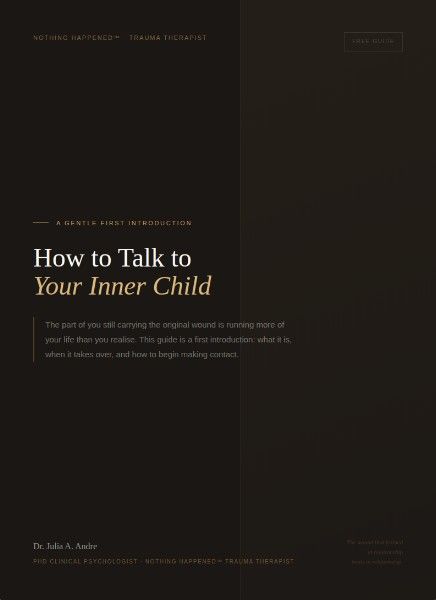
How to Talk to Your Inner Child
A gentle first introduction: what the inner child is, how to recognise when it's speaking, and how to begin making contact.
For therapistsWorking with DID or OSDD clients? The free Structural Dissociation Reference Card maps the whole system on one page.
Get the free reference card →