Dr. Julia A. AndreBeyond PTSD · Trauma Specialist
Clients / What I treat
Complex PTSD

CPTSD.
When it happened again and again.

“Something happened, again and again, and it shaped who you became.”

Complex trauma from prolonged or repeated experiences, often relational, often beginning in childhood. It shapes how you regulate emotion, trust others, and see yourself, long after it ended.

Sound familiar? Often shows up as
  • Overwhelm and numbness, swinging back and forth
  • Shame that won't shift
  • A deep sense of worthlessness
  • A harsh inner critic
  • An unstable sense of who you are
  • Tension you can't explain
  • Fatigue that doesn't match your life
  • A persistent void
How I work with it

Why CPTSD needs a different approach.

Standard PTSD treatment targets a single event. CPTSD comes from cumulative, relational injury, so this work builds safety and regulation first, then addresses identity and attachment, not just memory.

EMDR →Schema therapy →Body-based regulation
See the full approach →
Too much: overwhelm, panic, angerWindow of toleranceToo little: numbness, shutdown

Therapy widens the window: the swings become smaller, and more of life can be felt without tipping over.

Underneath

Parts of you still frozen in an earlier moment: still bracing, still protecting, long after the danger has passed.

Feeling undeserving of success, repeating the same partner pattern, parenting on autopilot, or burnout that won't lift are often that same protection, still running.

How I work with CPTSD

Safety first. Then the memories. Then the rest of your life.

01

Stabilise

We start with what keeps you functioning today: sleep, overwhelm, shutdown, the inner critic. You learn to notice when your system tips out of your window of tolerance, and how to bring it back. This is not a waiting room before the “real” work. For many people it is the first time their body feels any safer.

02

Process

Once there is enough stability, we work with the experiences that still feel present: EMDR for the memories and body states, and schema therapy for the beliefs they left behind, such as “I am too much” or “I am on my own”. The pace is set by what your system can hold, not by a fixed number of sessions.

03

Rebuild

The last phase is about identity and relationships: trusting people again, feeling your own needs, and living in a way that isn't organised around threat.

Common questions

What people often ask.

Is CPTSD a “real” diagnosis if it's not in the DSM-5?

Yes. It's recognised in the ICD-11 (2022) as distinct from PTSD, so it has formal clinical grounding even though the US diagnostic manual hasn't caught up yet.

Why does the shame feel so constant, not occasional?

Because it usually isn't a reaction to something you did. It's a chronic, background sense of being fundamentally wrong or unworthy, and it often formed as protection: believing “it was my fault” can feel safer to a child's mind than accepting there was nothing they could have done.

How is CPTSD different from PTSD?

PTSD usually follows one event or a limited set of events and centres on flashbacks, avoidance and feeling on guard. CPTSD includes all of that, plus lasting difficulties with emotion regulation, a deep sense of shame or worthlessness, and trouble feeling close to people. Those extra difficulties are why the treatment is paced and phased.

How long does CPTSD therapy take?

It depends on your history, your support and what you want from therapy, so I won't promise a number. We review together regularly how the work is going, so you always know where you are. Intensives can shorten parts of it.

Can CPTSD therapy be done online?

Yes. Research on online trauma therapy, including EMDR, shows results comparable to in-person work for most people. We plan together how you can keep yourself safe and grounded at home, before and after each session.

Do I need a diagnosis before we start?

No. Many people come with a sense that something is wrong rather than a label. If a formal assessment would help you, for example for insurance or your own clarity, we can do that as part of the first sessions.
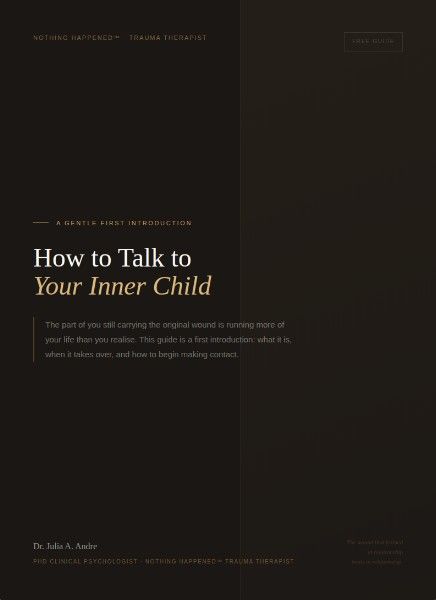
How to Talk to Your Inner Child guide cover
Not ready to talk yet? Start here, free

How to Talk to Your Inner Child

A gentle first introduction: what the inner child is, how to recognise when it's speaking, and how to begin making contact.


Free. Sent straight to your inbox. Unsubscribe anytime.

Keep exploring.

All resources →
Also treated Dissociation Quiet, high-functioning disconnection that is easy to miss. Read more → Also treated Omission trauma The wound formed by what was never given. Read more →
Related reading Why therapy isn't working, and it's not your fault. → Why EMDR changes for complex trauma. →
A leather sofa with a round cushion in a quiet, light room
If this sounds like you

Begin with a conversation.

A free 20-minute discovery call. No preparation needed, and no pressure to decide anything.

Book a free discovery call Get the free guide

This work is for adults (18+). I can't offer crisis or emergency support: if you are in danger right now, contact your local emergency number or find a helpline at Befrienders Worldwide.

Dr. Julia A. AndreBeyond PTSD · Trauma Specialist
Clients / What I treat

CPTSD.
When it happened again and again.

“Something happened, again and again, and it shaped who you became.”

Complex trauma from prolonged or repeated experiences, often relational, often beginning in childhood. It shapes how you regulate emotion, trust others, and see yourself, long after it ended.

Book a free discovery call Ways to work with me
Sound familiar? Often shows up as
  • Overwhelm and numbness, swinging back and forth
  • Shame that won't shift
  • A deep sense of worthlessness
  • A harsh inner critic
  • An unstable sense of who you are
  • Tension you can't explain
  • Fatigue that doesn't match your life
  • A persistent void
How I work with it

Why CPTSD needs a different approach.

Standard PTSD treatment targets a single event. CPTSD comes from cumulative, relational injury, so this work builds safety and regulation first, then addresses identity and attachment, not just memory.

EMDR →Schema therapy →Body-based regulation
Too much: overwhelm, panic, angerWindowof toleranceToo little: numbness, shutdown

Therapy widens the window: the swings become smaller, and more of life can be felt without tipping over.

Underneath

Parts of you still frozen in an earlier moment: still bracing, still protecting, long after the danger has passed.

Feeling undeserving of success, repeating the same partner pattern, parenting on autopilot, or burnout that won't lift are often that same protection, still running.

How I work with CPTSD

Safety first. Then the memories. Then the rest of your life.

01

Stabilise

We start with what keeps you functioning today: sleep, overwhelm, shutdown, the inner critic. You learn to notice when your system tips out of your window of tolerance, and how to bring it back. This is not a waiting room before the “real” work. For many people it is the first time their body feels any safer.

02

Process

Once there is enough stability, we work with the experiences that still feel present: EMDR for the memories and body states, and schema therapy for the beliefs they left behind, such as “I am too much” or “I am on my own”. The pace is set by what your system can hold, not by a fixed number of sessions.

03

Rebuild

The last phase is about identity and relationships: trusting people again, feeling your own needs, and living in a way that isn't organised around threat.

Common questions
Is CPTSD a “real” diagnosis if it's not in the DSM-5?

Yes. It's recognised in the ICD-11 (2022) as distinct from PTSD, so it has formal clinical grounding even though the US diagnostic manual hasn't caught up yet.

Why does the shame feel so constant, not occasional?

Because it usually isn't a reaction to something you did. It's a chronic, background sense of being fundamentally wrong or unworthy, and it often formed as protection: believing “it was my fault” can feel safer to a child's mind than accepting there was nothing they could have done.

How is CPTSD different from PTSD?

PTSD usually follows one event or a limited set of events and centres on flashbacks, avoidance and feeling on guard. CPTSD includes all of that, plus lasting difficulties with emotion regulation, a deep sense of shame or worthlessness, and trouble feeling close to people. Those extra difficulties are why the treatment is paced and phased.

How long does CPTSD therapy take?

It depends on your history, your support and what you want from therapy, so I won't promise a number. We review together regularly how the work is going, so you always know where you are. Intensives can shorten parts of it.

Can CPTSD therapy be done online?

Yes. Research on online trauma therapy, including EMDR, shows results comparable to in-person work for most people. We plan together how you can keep yourself safe and grounded at home, before and after each session.

Do I need a diagnosis before we start?

No. Many people come with a sense that something is wrong rather than a label. If a formal assessment would help you, for example for insurance or your own clarity, we can do that as part of the first sessions.

How to Talk to Your Inner Child guide cover
Free guide

How to Talk to Your Inner Child

Not ready to talk yet? A gentle first introduction: what the inner child is, how to recognise when it's speaking, and how to begin making contact.

Keep exploring
Dissociation→Omission trauma→Related articleWhy therapy isn't working, and it's not your fault.Related articleWhy EMDR changes for complex trauma.
A leather sofa with a round cushion in a quiet, light room
If this sounds like you

Begin with a conversation.

Book a free discovery call Get the free guide

This work is for adults (18+). I can't offer crisis or emergency support: if you are in danger right now, contact your local emergency number or find a helpline at Befrienders Worldwide.